How many revision rounds should you include in a quote?
Freelance quotes most often include two or three revision rounds per deliverable. Beyond that, each extra round is billable, as long as the quote says so clearly.

What counts as a round
A round is one full back-and-forth. You present a version, the client sends their feedback in one go, you make the changes. The next version opens the following round. Some people say revision or iteration; the word matters less than the definition written in your quote.
Without that definition, every client email can pass for a round, or none of them can. Three situations don’t use one up:
- a question from the client about the version you presented, with no change requested;
- fixing a mistake on your side, such as a typo, a broken link or a gap with the approved mockup;
- extra feedback sent before you started on the changes, which joins the current round.
On the other hand, a request that changes the scope (one more page, a new feature) has nothing to do with rounds. Handle it as an out-of-scope request, with its own estimate.
Common practice by deliverable
There is no standard, and we know of no reliable figure on what the profession does. The table below collects benchmarks that come up often in freelance quotes and contracts. Use them as a starting point, then adjust with the rule that follows.
| Deliverable | Common benchmark | What changes it |
|---|---|---|
| Logo and visual identity | 2 to 3 rounds, after the client picks one of the directions presented | Number of decision makers, number of directions shown at the start |
| Website mockups, per batch of screens | 2 rounds per batch | Batch size, whether colors and type were approved first |
| Built website | 1 to 2 rounds of fixes after the review | What was approved at mockup stage; a design change becomes an out-of-scope request |
| Website copy | 2 rounds per page or batch of pages | Copy written by you or supplied by the client |
| Booking app screens | 2 rounds per flow (booking, account, payment) | User testing between two rounds |
A rule to decide
- Start from two rounds per deliverable.
- Add one if more than two people sign off on the client side, or if the deliverable sets a direction everything else depends on (logo, colors, type).
- Take one away for a short, tightly defined deliverable, such as a banner built from an existing identity.
- Check that your price covers those rounds: estimate the time one round takes and multiply it by the number included.
Take a logo for a bakery. Say one round takes you 3 hours: reading the feedback, making changes, preparing the presentation. With two rounds included, the logo price has to cover 6 hours of revisions, which is $540 at $90 an hour. If the manager signs off with her two partners, go to three rounds, so 9 hours and $810.
The clause to write
The clause answers five questions: how many rounds, what a round is, how quickly the client replies, what doesn’t count as a round, and what an extra round costs. Here is an example wording to adapt.
This wording is an example, not legal advice. Adjust the numbers to your business and, for a large contract, have your terms reviewed by a lawyer in your country.
Also write the number of rounds next to each deliverable in the quote’s list. The client reads it when signing, and you can point to it on the day the question comes up.
What to do at round four
The client has used the three rounds included and sends a new list of feedback. Talk about the price before you open the file.
- Count the rounds already done and reread the clause, so you quote the right number.
- Read the list. If it’s about fixing mistakes on your side, do it without counting anything.
- Otherwise, reply in writing with the price of the round and the new delivery date.
- Offer another option: approve the current version and group the last changes into a later phase.
- Wait for written approval before you start.
Example message, for the mockups of a booking app:
Hi Thomas,
Thanks for the new list. The three rounds included for the mockups have been used. This fourth round costs $180, as set out in the quote, and moves delivery of the mockups to 14 November. You can also approve the current version and keep these changes for the next phase.
Let me know which you prefer, and I’ll start as soon as I hear back.
Best,
Julie
Get the client to consolidate feedback
Rounds are easy to count when feedback arrives in one batch. Ask for that at kickoff, with a few rules the client can tick off:
- one person sends the feedback and settles internal disagreements;
- feedback arrives in one batch, within the agreed time;
- each point is numbered and tied to a specific screen or page;
- the client separates what they require from what they suggest;
- comments go through one channel, on the mockup or in a shared document, rather than spread across emails and chat.
Each time you send a version, give the round number and the deadline in one sentence at the top of the message: “Here is version 2, the second of the three rounds included. Please send your consolidated feedback by 21 October.” The client knows where they stand, and round four doesn’t catch them off guard.
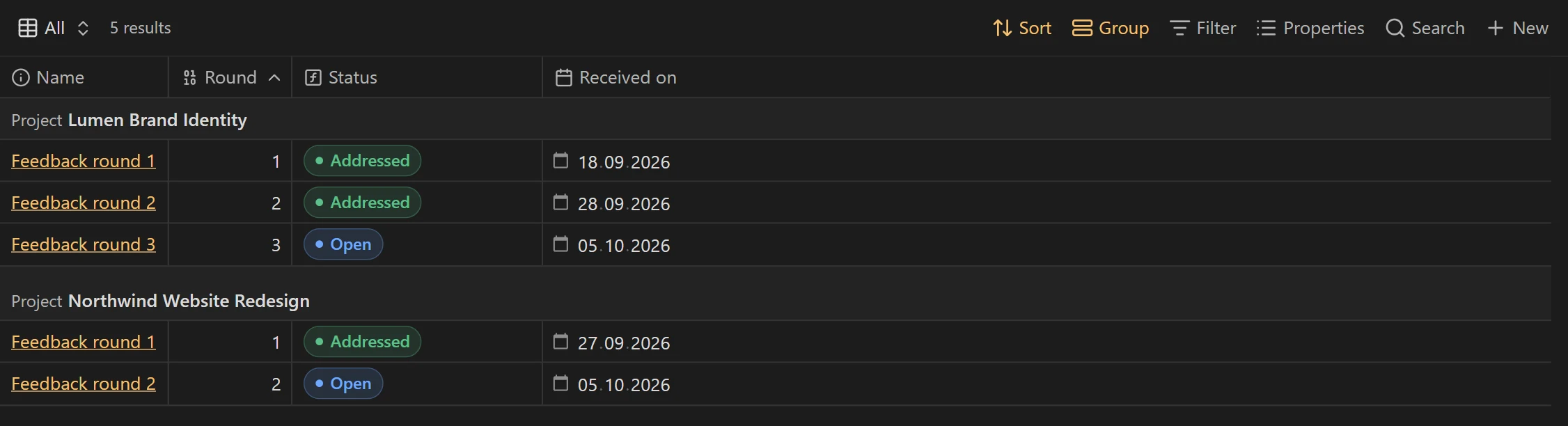
On your side, keep each round in a note: the date, the feedback pasted as is, and the list of changes. In ObsidianA free note-taking app for Windows, Mac, Linux, iPhone and Android. Your notes stay as Markdown files on your own computer. Brievora is a vault, a folder of notes and views that you open in Obsidian.obsidian.md, these properties are enough to track a project’s rounds:
---
type: feedback
project: "[[Pilates Studio booking app]]"
round: 2
status: open
received: 2026-10-14
---
A base filtered on type == "feedback" and grouped by project then lists each project’s rounds one under the other. The Obsidian Bases guide shows how to build it.
Questions
Does an unused round carry over to another deliverable?
That’s for you to decide and write into the clause. The simplest option is to count rounds per deliverable, with no carry-over, to avoid end-of-project debates.
What if the client never sends their feedback?
Set a reply deadline in the clause and what happens after it, for example the project goes on hold with a new delivery date. Follow up once in writing before you apply the rule.
Can I offer unlimited revisions?
Yes, if you limit the time instead, for example unlimited feedback for five working days, then delivery. With no limit on either time or number, the project has no predictable end date.
When should I tell the client how many rounds are included?
In the proposal, before they sign. Stated then, the limit is part of the price; discovered at round three, it feels like a bad surprise.