Scope creep: how to spot, price and answer out-of-scope requests
An out-of-scope request is work the client asks for that isn’t in the signed quote. You log it, estimate it in hours, then offer the client a change order or a later phase before you start.

Spot an out-of-scope request
Clients rarely label a request as extra work. It shows up as “one small thing” at the end of an email, or a “while you’re at it” on a call. To decide, reread the signed quote and ask yourself three questions.
- Is it written in the quote? A page, a feature or a deliverable that isn’t listed is out of scope, however small it looks.
- Is it fixing a mistake you made? A broken link or a typo you left behind gets fixed at no charge.
- Is it feedback during an agreed round? Changing a color during the second included round is part of the job. Changing the same color after final sign-off no longer is. The guide how many revision rounds to include covers that line in detail.
If the answer to all three is no, the request is out of scope. Here are a few cases from a website redesign for a bakery, quoted at five pages.
| Client request | Out of scope? | Why |
|---|---|---|
| Fix the phone number you copied wrong | No | Your typing mistake |
| Swap the home page photo during round 2 | No | Feedback within an included round |
| Add a “Cake orders” page | Yes | Not one of the five quoted pages |
| Change the heading font after the mockups were approved | Yes | The approved mockup set the font, going back reopens the work |
| Translate the site into German | Yes | The quote covers one language |
What six small requests cost
Take the same redesign. The quote covers 40 hours at $90 an hour, so $3,600. During the project, the client sends six requests, each one described as quick.
| Request | Hours | Value at $90/h |
|---|---|---|
| “Cake orders” page with a form | 6 | $540 |
| German version, translated copy supplied by the client | 4 | $360 |
| New heading font after sign-off | 2 | $180 |
| “Closed on Mondays” banner on every page | 1 | $90 |
| Instagram feed in the footer | 2.5 | $225 |
| Cropping 12 product photos | 3 | $270 |
| Total | 18.5 | $1,665 |
On its own, none of these requests is heavy: the longest takes 6 hours. Together they add 18.5 hours to a project planned at 40, which is 46% more work.
If you do them for free, you work 58.5 hours for $3,600. Your real rate drops from $90 to about $61.50 an hour ($3,600 ÷ 58.5 = $61.54). If you bill them, the project comes to $5,265. Either way, the schedule loses a little over two 8-hour days, taken from your other clients or from the launch date.
The clause to put in your quote
A short clause, written before the client signs, saves you from negotiating the rule halfway through the project. It says what the quote covers, how a new request is handled and what it costs. Here is an example wording to adapt to your business.
This text is an example, not legal advice. Rules on quotes and contract changes vary from country to country, so if the amounts are large, have your standard documents reviewed by a lawyer or your professional association.
The exact wording matters less than three things around it:
- a precise list of deliverables in the quote, which the clause refers to;
- written agreement before you start, even a plain email;
- an hourly rate or fixed price the client already knows, so the estimate doesn’t surprise them.
Answering the client: three messages
Reply in writing, within two days, and before you touch the file. Every reply carries the same information: the request in your own words, the estimate in hours and money, the effect on the delivery date and what you need to go ahead. The three messages below use the bakery project. Swap in your own names, hours and dates.
Accept with a change order
Hi Claire,
Thanks for the idea of a “Cake orders” page. It isn’t part of the quote from 12 September, which covers five pages. I estimate it at 6 hours, so $540, form included. Launch would move from 4 to 6 November.
If that works for you, I’ll send the change order and start as soon as you agree.
Best,
Julie
Move it to phase 2
Hi Claire,
A German version of the site makes sense for your German-speaking customers. To keep the 4 November launch, I suggest doing it right after, as phase 2. I estimate it at 4 hours, so $360, working from your translated copy.
I’m adding it to the phase 2 list, which already has the Instagram feed. We can go through it together at handoff.
Best,
Julie
Decline
Hi Claire,
I understand you want to post on Instagram every week, but I don’t manage social media and I couldn’t do it well. I can send you the names of two freelancers who do it very well.
The rest of the project is on track, with launch on 4 November.
Best,
Julie
Keep a record of every request
A request agreed on the phone and never written down rarely makes it onto the invoice. Log all of them, including the ones you give away. At the end of the project, the list shows the client what you did on top, and tells you what to plan for in the next quote.
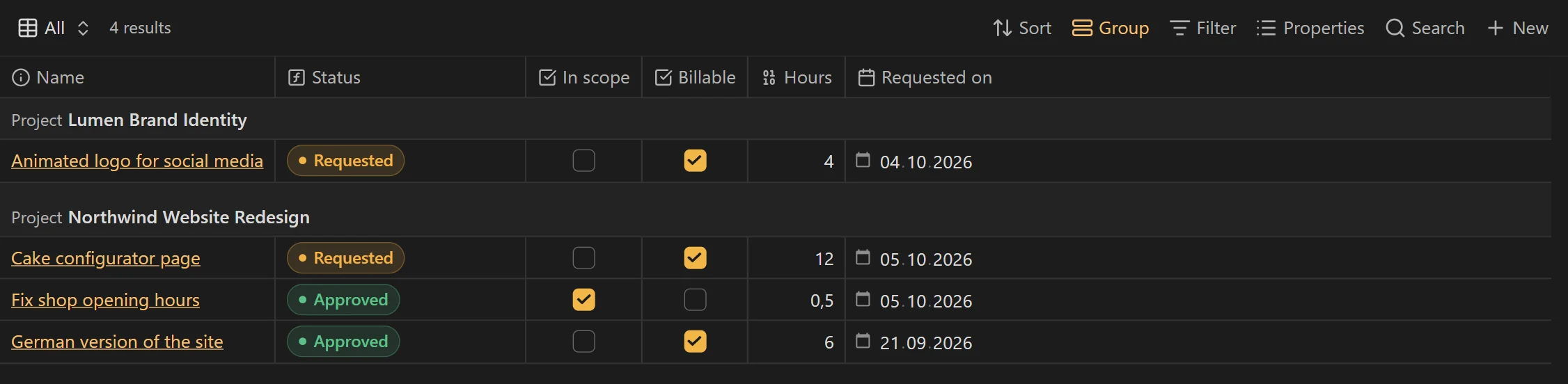
In ObsidianA free note-taking app for Windows, Mac, Linux, iPhone and Android. Your notes stay as Markdown files on your own computer. Brievora is a vault, a folder of notes and views that you open in Obsidian.obsidian.md, one note per request is enough. Its properties then let you sort the requests and add up the hours:
---
type: change-request
project: "[[Roux Bakery redesign]]"
status: pending
hours: 6
billable: true
requested: 2026-10-12
---
A .base file then gathers these notes. The first view lists the requests waiting for an answer. The second groups the approved, billable ones by project, with the total hours at the bottom of the column:
filters:
  and:
    - 'type == "change-request"'
views:
  - type: table
    name: "Pending"
    filters: 'status == "pending"'
    order:
      - file.name
      - project
      - hours
      - requested
  - type: table
    name: "To bill"
    filters: 'status == "approved" && billable'
    groupBy:
      property: project
      direction: ASC
    order:
      - file.name
      - hours
    summaries:
      hours: Sum
The Obsidian Bases guide explains how to create this file and show it inside the project note. For each request, check these points:
- the request is logged the same day, with the date and the client’s own words;
- the estimate you sent is in the note;
- the client’s written agreement is pasted or linked in the note;
- the status is current: pending, approved, postponed or declined;
- actual hours replace the estimate once the work is done.
Questions
Should I bill a fifteen-minute request?
Log it either way. You can give away a single small request, as long as you tell the client, or group several small ones into one change order at the end of the project.
What if the client turns down the change order?
The request stays outside the project and the original quote still applies. Since you haven’t started, you lose nothing, and you can offer it again as phase 2.
What if the need was in the brief but not in the quote?
Then the gap is in your quote. The fair move is to do the work without billing it, then check the brief line by line before your next quote.
Is an email enough as agreement?
A dated written agreement, even by email, beats a yes on the phone. For a large amount, a signed change order is safer; formal requirements depend on the law in your country.