Freelance rate calculator
Enter your income goal, taxes, costs and billable time to get the minimum hourly rate, day rate and project price to charge.
Your figures
How to calculate your freelance hourly rate
Your minimum hourly rate is the revenue you need in a year divided by the hours you can bill, with time off, prospecting and admin left out. That revenue is your net income goal divided by the share left after taxes and contributions, plus fixed costs and a safety margin. Multiply the hourly rate by your hours per day to get your day rate.
Example with the values the calculator opens with:
| Step | Formula | Example (excl. VAT or sales tax) |
|---|---|---|
| Revenue to invoice | (net income ÷ (1 − tax rate) + fixed costs) × (1 + margin) | ($48,000 ÷ 0.65 + $6,000) × 1.10 = $87,831 |
| Billable hours | working weeks × days × hours × billable share | 44 × 5 × 8 h × 65% = 1,144 h |
| Hourly rate | revenue ÷ billable hours, rounded up | $87,831 ÷ 1,144 h = $76.78, so $77 an hour |
| Day rate | hourly rate × hours per day | $77 × 8 h = $616 |
| Project price | hourly rate × project hours | $77 × 40 h = $3,080 |
To estimate a project’s hours, start from a complete brief: our free client brief generator lists the 11 questions to ask.
Method: taxes and contributions are calculated on profit, amounts are rounded to the unit at each step, and the hourly rate is rounded up.
· By the Brievora team
Three mistakes that lead to undercharging
- Dividing by full-time hours. $48,000 over 2,080 hours (40 h × 52 weeks), the way a salary is spread, gives $23 an hour and leaves nothing for taxes, costs, time off or unbilled work.
- Adding taxes instead of dividing. $48,000 plus 35% is $64,800, and only $42,120 is left once 35% of it is paid.
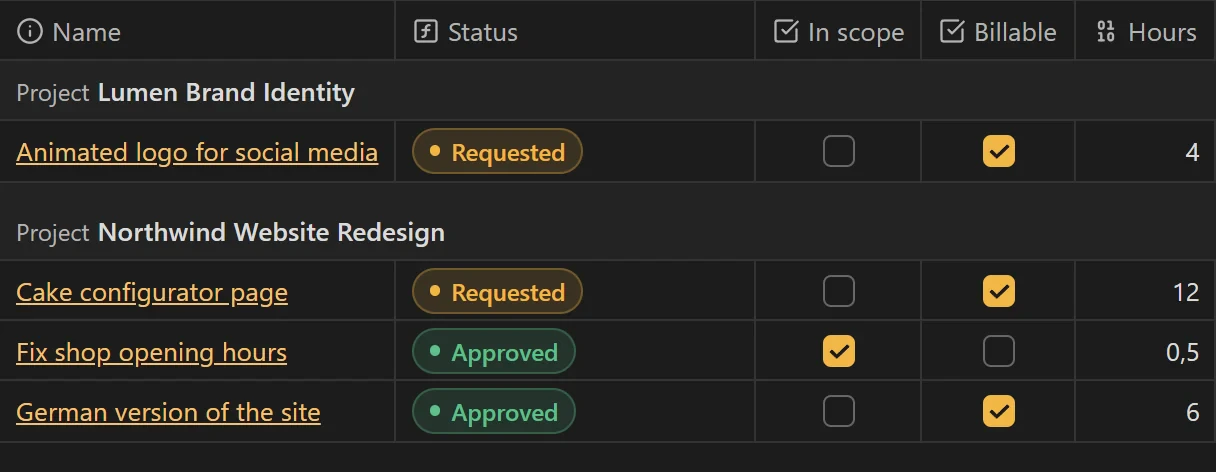
- Doing extra requests for free. Every unbilled hour lowers your real rate. Our guides cover out-of-scope requests and revision rounds.
Freelance rate FAQ
Another question? Write to us
How much should I set aside for taxes?
It depends on your country, status and income, so enter your own rate. In the US, count federal and state income tax plus self-employment tax; in the UK, income tax and National Insurance. To estimate it, divide last year’s taxes and contributions by last year’s profit, or ask your accountant.
How many hours can freelancers and contractors bill in a year?
Fewer than you work. Multiply your working weeks by days per week and hours per day, then keep only your billable share, also called utilization: no client pays for prospecting, quotes, admin or bookkeeping.
How do I convert a day rate to an hourly rate, and back?
Divide the day rate by the hours in your working day: $616 ÷ 8 = $77. To go the other way, multiply: $77 × 8 h = $616. If you bill 7-hour days, set Hours per day to 7; your day rate barely moves, because it depends on how many days you bill in a year.
Should I charge by the hour, by the day or per project?
Per project when the scope is written down and agreed; by the hour or the day when it isn’t, as with ongoing work or an unclear brief. For a fixed price, estimate the hours with revisions included and enter them next to “Project of”.
How do I turn a salary into a freelance rate?
Enter the take-home pay you want to replace as your net income goal, not your gross salary. Your rate then covers what an employer paid on top: paid time off, the employer’s share of contributions, equipment, and the hours you can’t bill.
In Brievora, every change request carries its hours, the project page adds up the billable ones, and invoices are tracked until they’re paid.
See Brievora